

|
|
|
|
|
Extract from the Curry Coast: Travels in Malabar 500 years after Vasco Da Gama
|
||
|
A bi-monthly magazine called Samanayam, one of the many hundreds that keep appearing off and on (editorial boards of many of these magazines have many common names) carried the anti-Gama debate a bit further. Akavur Narayanan, writing in what seemed to be the editorial, asked: ``How could we ever think of celebrating the anniversary of an event which caused the destruction of everything we had?''
The righteous indignation was quite contrary to what a Gamaphile wrote imperiously in 1970: ``The commemoration of the fifth centenary of the birth of Vasco da Gama is not only an act of a country that celebrates the memory of one of its most illustrious children, but equally of all humanity, which sees in Vasco da Gama one of the great argonauts of modern times.'' Everywhere there seemed to be pent-up anger against an events celebrating Gama's arrival - which nobody planned in the first place. There was no way professional symposium organisers of Malabar would let go an occasion to burn something. Usually it was the torchlit processions that was the culmination of meetings called to protect one thing or the other. The Gama quintcentinnial at least gave them the chance to burn effigies symbolising Western values, instead of used cycle tyres which made good flames that would burn late into the night. An opportunity to delve objectively into five centuries of maritime history was squandered. The only noteworthy event was the Alvares-organised seminar in Kochi.
Hotel Sagar, more centrally located, was attracting hordes of travelling Malabaris, specially families moving up and down to attend marriages. There was a traffic jam outside the hotel, which was a quaint double converted tiled-roof house. Peculiarly, it had a separate section which served subsidised food to the poor, a concept which I saw existed in a bar in Kochi where the riff-raff could go to a room behind and get slightly cheaper and maybe adulterated liquor.
Raman was also getting increasingly concerned at the steadily creeping influence of Islamic fundamentalism in Malabar. He had a valid point to make. When he was a student in Calicut, there was only one shop selling chadors. Today there are 14 exclusively devoted to selling the burqa. It wasn't an illiterate, unemployed section of the people who were opting or being encouraged to take to the burqa. Malabar's Muslim women were getting increasingly affluent and, of course, educated. Petite, cute children, who pranced along the roads to school with white embroidered scarves clipped on to their long hair, were being effortlessly led into burqas as they stepped waveringly into adolescence.
None of the minority complex affects the Kerala Muslim and nowhere in India is the integration of the Muslim population with the majority Hindu population so complete and so ideal. As a result of this, there is no ghettoisation of Muslims like in the rest of the country. Be it the police force, other Government services, in the cultural fields and sports, Muslims have made major contributions. A majority of Muslim soccer players emerge out of the sevens tournaments in Malabar have become major players with immense star value. Over and above that the Gulf boom has created a string of millionaires in Malabar, one of who had tied up with an oil multinational to develop a liquefied petroleum plant in Beypore. THE CURRY COAST WILL BE RELEASED IN LATE MARCH. PUBLISHED BY KONARK PUBLISHERS. FOR ENQUIRIES CONTACT 91-11-2204101 OR 91-11-2455731 OR FAX 91-11-2207103 |
| | About Us | Archives | Help | E-mail | Advertise | Legal Crap | Webmaster | | |
| Copyright © 1999 Jaal eZine™ | Designed & Hosted by [ iNetSol INDIA ] |
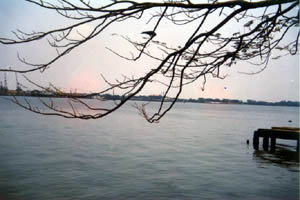 I spent the evening with my journalist friend Raman. The night culminated with generous amounts of beer, which Raman chased with rum and then we went to, where else, the Paragon Hotel, for the ultimate topping up of an exciting day - fried prawn and fried seer with pattiri. Paragon was not the only hotel that was at the same time the talking point and the eating point in Calicut.
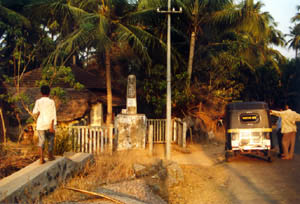 Raman spent all his career in the innocent fun-filled world of children's magazines, with their comic strips, folk tales, bedtime stories and riddles and puzzles, and has a detached view of the world of children and what amuses them. For him, entertaining children is as taxing a job as that of a chartered accountant. What is the new rabbit you pull out of the hat in every issue? What should that little booklet insert contain that makes little boys and girls around the State come to the paanwallah's shop and ask, ``Balarama Oondo? Balabhumi Oondo?'' Which syndicated comic strip should he buy?
 Interestingly, the black, silk flowing robe was being elevated into a fashion statement. Calicut must be the only place with a Muslim population where burqas were advertised in hoardings along with the life-size painting of a model in black. The 14 shops in the city were obviously wooing more women into the thick black folds of Islamic conservatism.